
eSignatures in finance: Вoosting efficiency and strengthening data security


- eSignature solutions have become a foundational technology for meeting both demands, and the eSignature market is estimated to grow by $ 43.54 billion by 2030.
- In the United States, electronic signatures now rest on solid legal and regulatory ground. The ESIGN Act grants eSignatures the same legal standing as handwritten ones.
- Regulators, including the SEC, FINRA, IRS, CFPB, and FFIEC, have explicitly enabled electronic signing across high-stakes workflows, from customer onboarding and disclosures to regulatory filings and executive attestations.
- Modern eSignature platforms have matured. Identity verification, audit trails, tamper-evident records, and role-based access controls now support regulator expectations for record-keeping, data protection, and dispute resolution.
The result: finance teams can digitize core processes end to end, reduce operational friction, and improve customer experience without increasing compliance exposure.
Why eSignatures matter for finance digitization
All major market players should stay up-to-date to keep the competitive features. It’s especially relevant when modern approaches make a level-up in simplicity, user experience, and more. Let’s explain in more detail where the current point of adopting eSignatures in finance is.
Financial institutions face a familiar set of challenges:
- Manual, paper-based workflows that slow down onboarding and approvals
- Limited visibility into document status and signer behavior
- High error rates and “not-in-good-order” rework
- Rising operational and storage costs
- Increasing expectations for digital, mobile-first experiences
eSignatures address these challenges directly by transforming static documents into auditable, identity-aware workflows. When paired with templates, structured fields, and integrations, they eliminate manual handoffs and reduce cycle times across lending, account servicing, compliance, and internal operations.
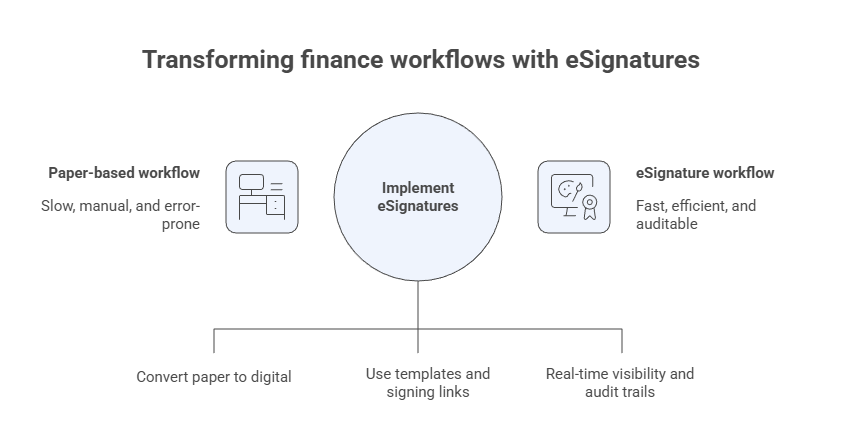
For SMB and mid-market financial organizations in particular, the ability to digitize quickly without enterprise-level complexity or cost has become a competitive necessity.
Regulatory readiness: eSignatures are no longer the exception
A clear legal foundation
Under the ESIGN Act (15 U.S.C. §7001), contracts and signatures cannot be denied legal effect solely because they are electronic. This statute underpins eSignature adoption across U.S. finance and is reinforced by sector-specific guidance.
Regulators are explicitly “e-first”
- SEC: Updated EDGAR rules allow remote online notarization for Form ID, removing a long-standing friction point for corporate finance and reporting teams.
- FINRA: Electronic signatures are permitted for customer account documentation and discretionary authorizations when governed by written supervisory procedures.
- CFPB (Regulation X): Required mortgage servicing disclosures may be delivered electronically when ESIGN consumer-consent requirements are met.
- IRS: Permanent acceptance of eSignatures for designated forms embeds digital signing into tax workflows.
- FFIEC: Federal banking agencies have formalized electronic signature standards for Call Report attestations and other recurring regulatory filings.
These changes significantly reduce perceived legal risk and make it easier for compliance teams to approve digital-first processes.
Identity, authentication, and auditability: the new baseline
Digitizing finance workflows requires more than capturing a signature image. Institutions must demonstrate who signed, when, how, and under what controls.
NIST guidance brings clarity
The latest revision of NIST SP 800-63 emphasizes risk-based identity assurance. Rather than a one-size-fits-all approach, financial institutions are encouraged to match signer authentication methods to the sensitivity of each transaction.
In practice, this means:
- Applying stronger authentication (e.g., MFA, phone verification, SSO) to higher-risk agreements
- Using consistent assurance mappings across document classes
- Balancing security with customer experience
Controls finance teams should expect from an eSignature platform
Finance teams should expect evidence-grade controls from an eSignature platform, including comprehensive audit trails with timestamps and IP addresses, tamper-evident document sealing, and role-based access to limit exposure. Equally critical are retention and reporting capabilities that support examinations and audits without manual work.
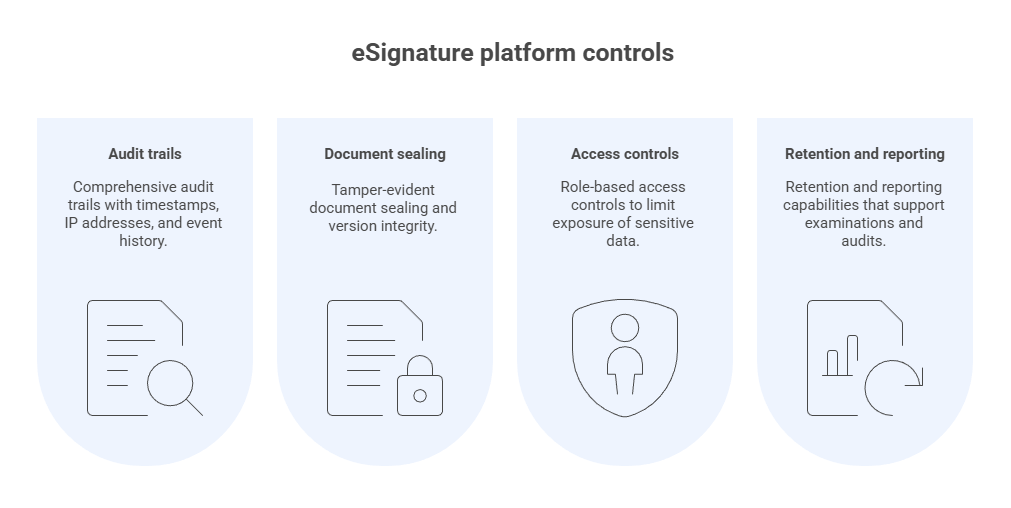
These capabilities are now table stakes for finance-grade eSignature solutions.
Adoption trends: digital agreements are becoming the norm
Customer behavior, lender priorities, and market momentum are all pointing in the same direction. Financial institutions aren’t digitizing in isolation: they’re responding to clear signals from users, regulators, and the broader technology ecosystem. Together, these trends explain why end-to-end digital agreements are quickly becoming a baseline expectation in finance:
- A majority of U.S. banking customers now prefer mobile apps as their primary channel, increasing pressure to digitize agreements end to end.
- Mortgage lenders report relatively low current eNote usage, but strong intent to expand adoption over the next two years as investor acceptance grows.
- The broader digital-signature market continues to expand rapidly, signaling vendor maturity and ecosystem readiness for regulated industries.
For finance leaders, the question is no longer if eSignatures are acceptable, but how quickly they can be operationalized across critical workflows.
What “good” looks like in practice
For finance teams, the case for eSignatures isn’t just about speed. It’s about doing more with less while staying firmly within regulatory boundaries. When implemented as part of a broader digital workflow, eSignatures deliver tangible operational gains and reinforce compliance by making processes more consistent, traceable, and auditable. This combination of efficiency and control is what makes eSignatures a practical foundation for finance digitization.
Operational efficiency and ROI
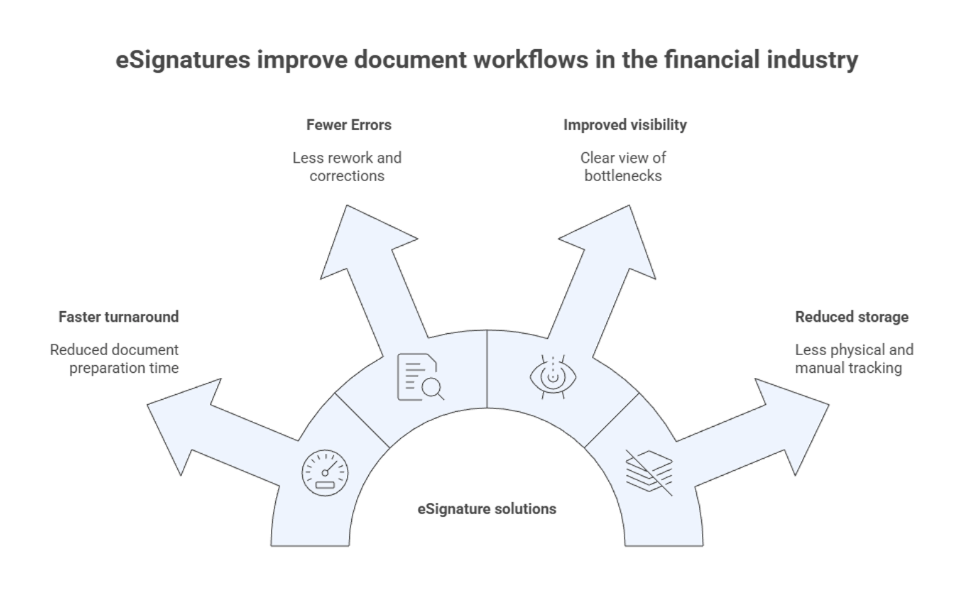
Independent total economic impact studies (commissioned by vendors) often cite triple-digit ROI and dramatic time savings. While these figures should be treated as directional, the operational gains are real and repeatable.
Risk and compliance alignment
Well-implemented eSignature workflows support compliance rather than undermine it:
- ESIGN-compliant consent capture for consumer disclosures
- FINRA-aligned documentation processes governed by supervisory procedures
- FFIEC-compliant executive attestations for regulatory filings
- SEC-enabled remote notarization for filer identity workflows
- The key is consistency, documentation, and platform-level controls.
What to evaluate in an eSignature solution for finance
When selecting an eSignature platform, finance teams should look beyond basic signing functionality and assess:
- Identity assurance options aligned to NIST guidance
- Depth of audit trails suitable for evidentiary use
- Document integrity protections over long retention periods
- Administrative controls and reporting for compliance and IT teams
- Integration coverage across CRM, ERP, LOS, and cloud storage
- Transparent pricing that scales without hidden fees
Where SignNow fits
For mid-market financial organizations, SignNow offers a pragmatic path to digitization.
SignNow combines a rich feature set with ease of use, enabling teams to move away from paper quickly without heavy implementation overhead. Unlimited users across paid plans support growth without penalizing scale, while transparent pricing eliminates surprise costs that often complicate budgeting.
Key capabilities, such as reusable templates, bulk sending, multi-step workflows, signer authentication options, and real-time tracking, map directly to common finance use cases, from customer onboarding and disclosures to internal approvals and regulatory documentation. Always-on support further reduces friction for lean teams managing compliance-sensitive processes.
Real-world finance use cases
Mortgage and lending workflows
Digitized closing packages, structured fields, and audit-ready signing reduce cycle times and support expanding eNote adoption.
Broker-dealer onboarding
Electronic execution of account documentation streamlines approvals and reduces NIGO errors when aligned with supervisory controls.
Corporate finance and SEC access
Remote notarization and eSignature packaging accelerate Form ID workflows while preserving identity rigor. Across these scenarios, the value of platforms like SignNow for the finance industry lies not just in faster signing, but in cleaner, more reliable processes.
A practical implementation blueprint
For SMB and mid-market finance teams getting started:
- Prioritize high-friction workflows such as onboarding, amendments, authorizations, and vendor contracts
- Map signer authentication to risk using NIST-aligned assurance levels
- Standardize templates and fields to reduce errors and rework
- Ensure auditability and retention meet examiner expectations
- Integrate with existing systems to avoid data silos
- Track measurable outcomes like cycle time, error rates, and abandonment
Conclusion
eSignatures are now a cornerstone of finance digitization. With a strong legal foundation, explicit regulatory acceptance, and clear identity guidance, financial institutions can confidently replace paper-based processes with secure, auditable digital workflows.
Over the next 12–24 months, expect continued acceleration in mortgage digitization, broader use of remote notarization, and more prescriptive identity requirements in procurement and compliance reviews.
For SMB and mid-market finance organizations, the ease, transparency, and scalability of eSignature solutions make it possible to modernize quickly while maintaining the trust, control, and compliance the industry demands.
Start your free SignNow trial today to see how it works for your organization!
Glossary:
- ESIGN Act: U.S. federal law granting electronic signatures and records the same legal effect as paper/ink.
- UETA/ESRA: State frameworks (UETA in most states; ESRA in New York) that recognize eSignatures’ legal validity.
- AAL (Authenticator Assurance Level): NIST scale (AAL1–AAL3) mapping transaction risk to authentication strength.
- Audit trail: Time-stamped record of all signing events (views, sends, IPs) used for evidence and compliance.
- Tamper-evident seal: Cryptographic protection that detects any post-signature changes to a document.
FAQ
1. How long does it typically take to implement eSignatures in a finance organization?
Implementation timelines vary, but many SMB and mid-market finance teams can deploy eSignature workflows in days or weeks. The fastest rollouts usually start with high-volume, low-complexity documents (such as onboarding forms or internal approvals) and expand from there.
2. Do eSignatures work for multi-party or sequential signing workflows common in finance?
Modern eSignature solutions are built to support complex, multi-step workflows involving multiple internal reviewers, external signers, and conditional routing. This is especially useful for finance use cases like loan approvals, broker-dealer documentation, or vendor contracts, where documents often require signatures in a specific order and visibility into each step of the process.
3. How do eSignatures impact customer experience in regulated financial processes?
When implemented thoughtfully, eSignatures significantly improve customer experience without compromising compliance. Customers can review and sign documents remotely, on any device, without printing or scanning. Clear signing instructions, fewer errors, and faster completion reduce friction: an increasingly important factor as customers expect finance interactions to feel as seamless as other digital services.
4. How does SignNow support compliance without slowing down finance workflows?
SignNow embeds compliance-friendly controls, such as audit trails, document integrity protections, and configurable signer authentication, directly into everyday workflows. This allows finance teams to apply consistent controls across documents while keeping the signing experience simple for customers and internal users. As a result, compliance requirements are met within the process rather than layered on afterward.
5. What internal teams should be involved when rolling out eSignatures in finance?
Successful adoption usually involves collaboration between operations, compliance, IT, and the business owners of each workflow. Operations teams help identify inefficiencies, compliance teams validate controls and documentation, and IT ensures integrations and access management align with internal standards. Early alignment helps avoid rework and speeds adoption.
6. Why is SignNow a good fit for SMB and mid-market finance teams?
SignNow is designed for teams that need finance-grade controls without enterprise-level complexity or cost. Unlimited users across paid plans make it easier for growing organizations to scale adoption across departments, while transparent pricing helps finance leaders plan without unexpected fees.
- Why eSignatures matter for finance digitization
- Regulatory readiness: eSignatures are no longer the exception
- Identity, authentication, and auditability: the new baseline
- Adoption trends: digital agreements are becoming the norm
- What “good” looks like in practice
- What to evaluate in an eSignature solution for finance
- Where SignNow fits
- Real-world finance use cases
- A practical implementation blueprint
- Conclusion
- Glossary:
- FAQ
- 1. How long does it typically take to implement eSignatures in a finance organization?
- 3. How do eSignatures impact customer experience in regulated financial processes?
- 5. What internal teams should be involved when rolling out eSignatures in finance?
- 6. Why is SignNow a good fit for SMB and mid-market finance teams?
